A few years ago, my daughter got a turntable for Christmas and I started taking her to record stores. While I was there I realized that I too liked physical media, but vinyl just wasn't my thing. I did have a hundred or so CDs in the attic. Maybe it was time to see if they were still any good?
Turns out, CDs are pretty durable. Even though my attic gets crazy hot in the Texas summer, none of the CDs (some 35 years old!) failed. Next thing I needed was to buy a CD player (again). I was somewhat surprised by how few companies are still making players, but I got an Onkyo unit that I'm happy with.
Now I have a pretty great sounding setup and I have little booklets to examine while I listen. Browsing the collection for something to play is fun.
I'm back to buying CDs and it's actually a great time to be buying this stuff. New and used is cheaper than ever (lots of stuff is the same price it was 30 years ago) and so much stuff is available online and off. I love going to Waterloo Records in Austin and flipping through the stacks to buy a couple titles from my list and probably another title or too because I liked the artwork on the case or the guy at the counter recommended something.
I also bought a small bookshelf system for my desk because popping in a disk then having some music for maybe an hour then having to get up to change it works well for me. If I'm streaming from Spotify I end up working for too long, often unproductively. Taking a break every hour or so and shifting my attention (take the dog outside, make some tea, change the CD, then back to work!) seems to help my problem solving skills. I look at it as a healthier version of a cigarette break.
The only problem I've had with my disks is that a couple of them seem to not be balanced perfectly and they make a bit of mechanical noise in the player as they spin.
This is a testament to how well Reed-Solomon encoding/decoding [1] can detect and correct errors! I remember even heavily scratched cd's would work if you cleaned them with toothpaste of all things (?) [2]
This is unlike blowing an NES cartridge, which actually had a detrimental effect due to blowing spit on the pin contacts and oxidizing them.. [3] I do remember Babbages/KB Toys/etc did actually sell NES/SNES/Gameboy cartridge cleaning kits though [4].
> I remember even heavily scratched cd's would work if you cleaned them with toothpaste of all things (?)
I've had even better results with this three-step stuff that's actually meant for plastics, with most scratches not needing more than step 2: https://novuspolish.com/
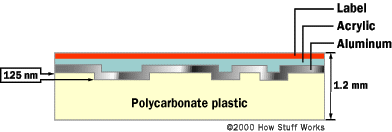
That works great for bottom-side scratches, but sadly it's not usually possible to repair any damage done to the label-side of a Compact Disc due to proximity between the label and the reflective data layer underneath. It's really common for well-intentioned people to remove discs from a drive and (in absence of the case) set them upside-down to "protect" them not realizing it's the worst possible thing they could do. All-over-print labels add an extra margin of protection over discs that leave the label's negative space as bare disc silver: https://cdn.hswstatic.com/gif/cd-crosssection.gif
Novamin turns into hydroxyapatite, like in Japanese toothpastes. Fluoride and nanohydroxyapatite work better together than either alone, for carries at least. The approval process is too expensive to get through here, even though nanohydroxyapatite is used regularly in many countries.
Adding this to my list. I've definitely ramped back up into the CD game myself.
I think I have spent $2k between la-la-land and Discogs this year already...
The biggest catalyst for this was Spotify removing content from their platform, presumably due to licensing issues. I don't like the idea that someone could memoryhole a piece of art that I had previously experienced.
It's great that your CDs in the attic weren't damaged. However, please don't store your CDs there.
Since you're in the Austin area you might also want to check out Astro Records in Bastrop (30 minutes east). Very friendly and knowledgeable owner. Vinyl is the bulk of his inventory, but he also has a decent collection of CDs for sale.
I used to have a large CD collection. I bought them and I sold them. I bought second-hand and new. It was fantastic.
And then one day I moved overseas and one of my CD boxes got lost in the mail.
And then, some other day, the bottom box of my CD boxes that were temporarily stored in a basement got flooded and destroyed.
Now I don't give a shit about CDs. I have unapologetically pirated the music from CDs that I used to own but got lost or destroyed, and for all my new music I bought it online and back up the digital files to the cloud. I'll never lose music I paid for again.
CDs are legacy media for a reason. All other legacy digital media will follow it, except for the small group of people who fetishize it for nostalgic reasons. There is a tiny argument that still exists for buying legacy analog media - the "it sounds warmer" argument. But honestly, you could just pipe your digital files through a filter and get the same effect, so, meh.
> There is a tiny argument that still exists for buying legacy analog media - the "it sounds warmer" argument.
There are more arguments than that. For some people, it's all about collecting and community. For others, they love the large format artwork. I'm not playing analog media, but I still like the physical interaction part. Many of us also like that, for some artists, buying a record is a way of supporting them. Then there's the fact that playing a record or CD doesn't require an internet connection and that means nobody is tracking the records you play today in order to better sell things to you tomorrow. There's also the gear part - it's an excuse to put together a great audio setup. For those of us who still buy physical media, I don't think the "it sounds warmer" argument is terribly common.
All of this stuff is fun. There's not a lot of joy in tapping "dylan blonde" into a search box and pressing play.
I completely understand the hobbyist appeal - it's the same reason why people still buy hard copy books and comics - but from the average consumer perspective there's no real reason to do it since you can easily buy the same or better quality tunes direct from digital distributors.
Nowadays I most only buy music on Bandcamp, and if I want to throw more cash to the artist there are other venues like Patreon or even just a Paypal account where I can do that. Paying for physical media or merch is of course another indirect way to funnel money to the creators, but if getting money to the creator is the main goal, there are often more efficient ways to do it too.
> the same or better quality [...] direct from digital distributors
Not wanting to object fundamentally, as enough of my recent music purchases have indeed been digital downloads, however I'm still glad that at least for now CDs still exist and provide an alternative option:
- Some digital releases have been somewhat mangled in a very minor (the mouse squeak at the end of 3:47 EST is missing) or somewhat more major (several live albums/albums with live content of Bob Dylan's Bootleg Series are missing the pre-gap material between the individual tracks) fashion. Okay, in the former case I've simply grabbed the squeak off a Youtube recording and edited it back on, but in the latter case just getting the CDs is the most sensible option.
- Cover art beyond the front cover and liner notes are mostly missing. Okay, sometimes they're forgettable anyway and after all the music is the main thing, but sometimes it's still a bit of a shame to miss out on those things. In principle at least Apple/iTunes does have facilities for including a PDF booklet together with an album download, but in practice at least for the kind of music I'm interested in, encountering such a thing seems to be the exception rather than the norm. The Bootleg Series again is being a culprit here – personally I find the liner notes definitively interesting to read, but online you're getting none of that. (On the other hand kudos to whoever made sure to include the booklet for the Traveling Wilburys Collection on iTunes!)
- Occasionally (not often, but definitively sometimes), the (new, not used!) CD turns out to cost noticeably less than the digital download.
- Remasters are par for the course (though in some circles even those can provoke heated discussions about whether a certain remaster is really better or not), but with remixes the difference is more immediately noticeable even to someone like me. Sometimes remixes are being offered as an alternative version, and you can still buy the original version if you prefer that, but sometimes the remixed version is replacing the original albums. Online that means that subsequently piracy is your only choice of still obtaining the older mixes, whereas with CDs you've still got a chance on the second hand market.
- Where live albums are mastered with a pre-gap between tracks, it turns out I sometimes (e.g. especially when there's some stage banter related to the upcoming song) prefer the pre-gap to be tacked onto the beginning of the next track instead of the end of the previous track as seems to be the usual standard. When ripping a CD myself I can easily adjust that, when buying a download less so. (Having the pre-gap at the start of a track does have the trade-off that the music doesn't start playing immediately, but on the other hand during shuffling it means that any preceding stage banter remains together with the track it belongs to, and personally I find the latter more important.)
Though I guess you can classify some of those objections as somewhat "hobbyist", too… :-)
I generally agree on all of your points. Trust me, some of the CDs I lost in that flood were extremely rare and don't exist anywhere to purchase or download. They were tragic losses. For years I had a discogs.com account that I meticulously updated with everything in my collection.
I get that there are differences between what is legally available as the "best" remastered version of the album and the original version as it was released on record or tape or CD back in the day. But if your goal is not to give money to the artist and instead just find the best version of the song, you can usually better do that through piracy. The artist doesn't get any money either way - whether you bought a second-hand album from your local record store or downloaded a version online - who cares?
The one case where original media is interesting is if nobody made a version available online via piracy. And that's a sad state of affairs. As I mentioned earlier - I have lost dozens of CDs that never got released online, because they were small runs on indie labels or just independently released back in the day before the internet was a thing... Well now every time one of those sorts of CDs gets destroyed in a flood, it's one less copy of that song in the wider world. If anything, people should be uploading the fuck out of all they got, because otherwise all those great indie artists of the 90s (never mind the decades prior) will disappear into obscurity and what's the point of their music then?
Digitize everything is my opinion. Digitize it, upload it, share it. It's the best way to preserve the culture of past years/decades/eras.
I was at Philips during an R&D period experimenting with alternative data formats for CD ROMs.
A capability I liked that never went public was removing the error correction portion of sectors of data, transforming the 2K per sector into something slighter bigger 2356 bytes. Anything to get more bits off the disk back when it was limited to 128K per second. This was interesting because it allowed the developer to selectively say "this data can survive some data loss, and it's fine".
Another feature that never went public was "real time files" - multiple files interleaved sector by sector on the disc such that at a given time after a "real time file play" has begun you're guaranteed the data from the interleaved files are in memory, with per-file-sector callbacks if requested. (And if you wanted, the different files could have full error correction or not, 2K or bigger sectors selectively.) Never used for, but would have been great for loading game levels where multiple files land all over memory, but streamed all at once.
Well, Philips did actually define these capabilities in a standard known as "Extended Architecture" (XA). CD-XA introduced Mode 2 sectors, which could hold 2048 bytes of data with ECC, 2324 bytes of custom data without ECC or even a chunk of ADPCM compressed audio to be played directly by the drive without intervention of the host CPU. ADPCM sectors could be "spread out" throughout custom data, so the drive would play them while the host would only receive the non-audio data (such as video frames). Multiple ADPCM tracks could also be interleaved, allowing playback of compressed audio at the same drive speed as regular CD audio with no need for buffering.
Now, CD-XA unfortunately didn't take off... or did it? It was initially only supported by the failed Philips CD-i, but it turns out that a few years later Sony would reuse most of the technology for their upcoming game console. That's right, the PlayStation 1 made heavy use of XA and of its audio capabilities; the system's native video format was in fact a custom container format interleaved with XA ADPCM audio, and many games took advantage of the ability to interleave multiple audio tracks as well.
Video CDs also used 2324-byte Mode 2 sectors without ECC by the way, but I'd say their popularity was far below that of the PlayStation 1.
FWIW, CD-XA's presence in the first PlayStation might be due to my influence. I was the "Philips streaming guy" hired by Sony who worked with the streaming libraries and the OS subsystem devs in Tokyo, during the development of the initial PlayStation OS. In a series of architectural design meetings I helped their developers understand the whys and hows of real time files and the architecture necessary within the OS to support them.
Games definitely had custom "put this data on this sector" software, for authoring their gold masters. Generally, data that was needed fast was on the outer tracks, since they spin faster and can have lower seek times. Something less time-critical like background music would be on a slower part of the disk, streamed incrementally.
The Quietus did a piece[1] celebrating the anniversary, remarking on the pregap[2] and how various artists would leverage it:
> On their third album, 1999’s Guerrilla, Super Furry Animals slipped one of their best songs, ‘Citizens Band’, into the pre-gap, that is, the neverzone before the album proper. Autechre pulled the same trick, in the same year, on EP7, hiding an eerie six minutes of intricate sound design which seems years ahead of its time, and then three minutes of silence, before ‘Rpeg’. They did it again, including the untitled track in the pre-gap to the fourth disc of EPs 1991-2002.
> Pre-gap tracks are a CD-specific phenomenon, paralleled only by DVD Easter Eggs, or hidden levels in a computer game. On the one hand, they’re only possible digitally, on the other, they seem to be an attempt to add some mystique to a circle of plastic. They are a defense of the physical medium because it is impossible to rip them to your computer. Finding them meas having a bit of extra knowledge about the artist, uncovering a hidden layer of depth others hadn’t noticed.
> Earlier, experimental artists took even greater strides into the CDs unique sequencing possibilities. Otomo Yoshihide’s 1993 release The Night Before the Death of the Sampling Virus is a fluctuating voice collage designed specifically for the medium. Its 77 tracks are tiny, most less than a minute, few going above two. The listener is encouraged to hit the random option on their hi-fi. “To play this release in random mode is to allow the SAMPLING VIRUS to regenerate, to mutate with near infinite possibilities.”
> Eccles, UK-based experimentalists Stock, Hausen, & Walkman encouraged listeners to do something similar with their debut album, Giving Up. From the release notes: “The Original CD had 60 ID points deliberately inserted in the middle of a lot of the tracks so that random play would cut the music up and present the listener with a new and unique 'remix' version if desired.” There were things you could do with a CD, that you definitely couldn’t do with a tape or LP.
> because it is impossible to rip them to your computer
Which luckily isn't actually true. They might or might not have been problematic with certain software and/or disc drives, but in principle – especially these days – they can normally be ripped without any difficulties.
(Nevertheless, Columbia/Sony still managed to lose all the pre-gap material from a number of live Bob Dylan Bootleg Series albums while uploading them for digital distribution, so all streaming services and download stores currently only have faulty versions of those albums. Maybe they really ripped the physical discs in order to upload them and somehow chose the wrong settings?
As silly as that theory sounds, in another coincidence on iTunes, none of volumes 1 to 10 – the actual releases affected are 4, 6, 7 and 10 – inclusive bears the "Apple Digital Master" logo, so Columbia/Sony actually uploading mangled CD rips remains a distinct possibility…)
I bet a lot of people here fondly remember They Might Be Giants' Apollo 18 album, which had about 20 short tracks meant to be shuffled. But we listened to the album in order enough times to be able to sing the random tracks from memory anyway.
But I like going to second-hand stores and buying CDs for a dollar: if you like the first song, it's like getting a non-curated Spotify experience that can expand your tastes.
Also, the presence in the store means 1) someone though it was interesting enough to buy it in the first place 2) someone thought it was interesting enough to try to resell it, so it's non-curated in the sense it's not specially tailored to your specific tastes, but still good enough to have been deemed worth selling twice.
I haven't done this in quite awhile, but I used to do what you were describing at a local Goodwill; I'd find a CD for a band I had never heard of (or had only a passing knowledge of), give it a listen in my car for a few days. The CD would only be a buck or two, so I figured that if I like even two of the songs then I'm ahead of the iTunes price. This is why I'm big Pink Floyd fan now; I had passively heard of Dark Side of the Moon, and when I saw the CD going for a buck at Goodwill I figured it was worth a listen.
Sadly, I more or less stopped doing this the second that I got a Spotify account.
> I'd find a CD for a band I had never heard of (or had only a passing knowledge of),
I do that, but also for genres: it's a bit like buying games on Stream: I build up a stack, then I consume it piece by piece until I can start appreciating its unique contributions compared to other genres.
Then once I find an artist I really like, I dig deeper into their earlier work and their feats.
Right now, after exploring Reggaeton then french Pop-Urbaine, I'm digging deeper into meditative music and 2000s EDM (well, separately, not both at the same time :)
> give it a listen in my car for a few days
Oh yes, the car trick is great! Old cars have CD players! And that's how I've become a fan of Pop-Urbaine: buying CDs during travel.
> The CD would only be a buck or two, so I figured that if I like even two of the songs then I'm ahead of the iTunes price
It's not just a question of price: for me, it's more about curation.
Besides the entire genres, there are some artists I would never have discovered without this "one weird trick".
Then once digging deeper, even for well-known artists, there are some obscure songs that I end up really liking!
I do this frequently when vacationing. A lot of thrift store CD stocks have been picked over in recent years, but with enough flipping I can frequently find something that maybe has a gold nugget on it. Then I rip it to my collection (currently about 1300 CDs worth).
But I’m a bit surprised how the inventory has shrunk over the last 5 or 6 years. Cmon people, unload your old CDs at thrift stores! :)
I used to do that all the time, it introduced me to some great/weird stuff. Always found something interesting to listen to while driving. Unfortunately I switched to a car that only has a tape player, and while you used to be able to do the same with cassettes it's getting much harder to find them.
I will still occasionally buy CDs (I bought my first player in 1984 - the Sony CDP-101), but I'm a lot more critical about what I buy now. For the past 10-ish years, the studios have been eliminating dynamic range and cranking the knob on their compression software to "11". As a result, music has become painful to listen to.
The name for this is the Loudness War, and with the exception of titles like Daft Punk's Random Access Memories, we are losing.
I think the only regret that the labels have (to our benefit) was the failure to include DRM because… it was 1982. Other than a single optional “pls don’t copy me thanks” bit.
Since then, we’ve had multiple attempts to replace CDs with higher-fidelity, DRM-damaged replacements like the SACD, DVD Audio, SDMI/DataPlay, and even Blu-ray Pure Audio formats - and later with all iTunes purchases before 2009 despite the CD existing. All failures. Digital music is DRM-free and not going back, thanks to the CD.
What HASN'T failed as a post-CD development, though, is the advent of all-you-can-eat streaming services like Apple Music and Spotify.
The music you get under these deals is never yours, but the price is so low that it's a reasonable trade for many people, myself included -- even though I was for decades (I'm 52) a serious collector of CD and eventually vinyl.
I still buy CDs but Apple Music's spatial audio is the first new gimmick that I'm impressed by. If the rest of my family didn't prefer Spotify, I'd switch to it.
As far as I know, Apple’s Spatial Audio is actually rebranded Dolby Atmos tracks with Atmos playback enabled. I don’t really blame Apple because what the heck is an “Atmos?” “Spatial audio” is more self explanatory than that even if still a bit obtuse.
You can also get it on PC, for example, by paying $15 for the “Dolby Access” app and playing an Atmos track.
None of your links support the claim that these discs could damage your loudspeakers. That's the mythical part.
The final stage in digital-to-analog conversion is a reconstruction filter that removes the non-sonic contents of the output. There's nothing you can put on a CD that will destroy your loudspeakers.
> I remember there being a CD that when ripped would intentionally damage/destroy the speakers with some type of frequency sweep or noise.
I don’t remember this one. I tried to find it but Google is littered with CD recommendations to “break in” speakers because “break” is a synonym for “destroy”.
There were quite a few actually, most of this was sony's doing.
The most destructive was XCP around the time of MediaMax, which used randomness in what tones they produced, which would damage speakers unpredictably.
"MediaMax introduces a large amount of random jitter, making the
disc sound like it has been badly scratched or damaged;
XCP replaces the audio with random noise."
Key2Audio was the first tech that comes to mind that did this, originally employed on Celinne Dione's "A New Day Has Come" album. It would cause all types of issues, but one being random audio blips that sounded like when you turn on a bitcrusher and press the overdrive, it's easy to see how this can damage a speaker.
That’s insane. I remember the Sony Rootkit scandal from 2005 and Sony’s reputation started to tank around then but I didn’t know it was the successor to another piss poor attempt to copy protect CDs.
They tried very hard after the PC became capable of making clones… but Phillips prohibited them from using the CD trademark proper because they were never as compatible as they needed to be. And there were embarrassing lawsuits. The law speaks louder than complaining users or a stubborn executive.
I just recently dragged my bin of 100s of CDs from the garage and ripped them all on to a server on my network. I think I may stick with it. It's gotten me buying a lot of physical CDs again, plus a little portable CD rom drive, since I no longer even own anything that can play them.
I honestly am not 100% sure why I like this so much more. Spotify can do the same thing. You can "heart" albums and then they show up in your "library", but there's just something that makes that so clunky to deal with. When you open the app, you get radio stations and podcasts. I love opening an app and just seeing album covers. I dunno, maybe I'm crazy.
> I love opening an app and just seeing album covers. I dunno, maybe I'm crazy.
I feel the same way, something fun about knowing my digital rips are the exact same edition as the physical object I can go pick up off my shelf instead of an album being some nebulous thing that might have extra tracks or a different mix depending on how I listen to it. I always type out my discs' catalog number in the Comments tag of my rip for that reason.
Also the predictability that my music will never disappear due to losing some distribution license (learned this lesson with Rdio), that I can never be out of network range, and that it is incapable of spying on me because it is incapable of using the network at all. I love the combo of old would-otherwise-be-ewaste Android phone + Musicolet + yuge SD card + my own CD rips for music in my car: https://i.imgur.com/HSSouVT.jpg
I'm old enough to have purchased cassette tapes in the early MTV days...and found compact discs to be amazing little pieces of technology when they started to become mainstream.
Fast forward to a time when I actually had the resources to purchase my own audio hardware, including a nice low-THD amplifier and decent quality floor-standing speakers in a 5.1 configuration.
Enter disappointment when I realized that while it was possible for my amplifier to split the input signal across all 5 channels plus the LFE channel, the music source was only encoded in 2-channel stereo. Then I went down the SACD, DVDA, etc route for a bit, only to end somewhat frustrated that it required hoop-jumping to get good quality multi-channel source material.
I haven't endeavored in this realm for some time now. Mostly, while coding I just use my Schiit Modi with some KRKs in my office for 2-channel stereo listening via a mix of Spotify and local FLAC files. However, I do wonder if anyone here has any recommendations for finding multi-channel digital music that I could enjoy in my home theater where a true decent quality multi-channel setup exists?
Aren’t most Blue-Ray audio disks multi channel 5.1? It looks like a pretty mature industry with many albums available even at major retailers like Amazon.
Or do you mean digital in the sense of available to download?
My physical media collection is large and awaiting the day… because I have a sense that movie studios and music companies really don’t want a resurgence… mainly because that would damage the all-important subscriber numbers, and cause more people to have the DRM-cracked-on-all-of-them copies which can be resold…
Movie studios must hate reselling. Buy a movie on iTunes? $15, strong DRM, never able to be resold. Buy it at Goodwill? $3, weak DRM, no new profit whatsoever. Also the iTunes version can be edited in the future to remove anything inconvenient, but the disc can’t.
I was thinking more along the lines of VR experiences that are sufficiently advanced and detailed as to necessitate multiple large hybrid ML models and asset banks, consider what a Dall-E might look like in such a use case in the next 10-15 years.
It's still the Pong days for these things, and no one knows if their realistic usage will involve on-device compute resources for such a deployment.
It’s pretty obvious that this will all be cloud based. I just don’t see people wanting to have a full rack of hardware in their houses, when many are already opting out of even small things like laptops in favor of mobile and iPads. The business models of any company providing an AI service definitely would not even consider on-prem when recurring subscription fees are so well accepted by consumers now.
I disagree, large broadly-based language-involved models might need that, but a performance-adaptive scope-specific application like texturing might just need part of a single graphics card's processing time, or an SD-card sized cache with narrow-register parallel processing on-board.
So much BS here. Having participated in this discussion a few times, I'm baffled by the "vinyl sounds better" argument (it doesn't), yet I have large collection of vinyl which I absolutely love. I think CD's sound terrific (they really do, especially vintage discs), but physical media has far more appeal than just "nostalgia". I also enjoy cassettes, minidisc, and reel to reel.
I really do enjoy the physical nature of the media. I love the mechanics of the various machines that are needed for playback (I've been collecting personal CD and minidisc players for the past couple years). The accompanying printed material is truly delightful. My reel to reel is quite finicky and yet threading the tape leads around the various post and across the magnetic heads is magical. Every time.
I think my biggest objection to digital streaming services is this: My music disappears unless I keep up with the monthly payment. These companies control what is available. Robert Mitchums's attempt at the native music of Trinidad in his album "Calypso is Like so..." is utterly compelling regardless of the cultural appropriation. This music brings me so much joy. The vintage CD's are out there by the bundle for pennies. What a treasure trove.
I just purchased Lorde's "Solar Power" album. Its not available on CD. I took the wave files and created my own CD complete with printed front and back liner notes and art work. My Epson allows printing on CD discs and the final package looks amazing (And I enjoyed designing it myself).
Don't get me started on the absolute joy of minidisc. Just about every vinyl album I treasure has been captured by this medium so I can listen on the road.
I also enjoy streaming music, but it should be noted that I spend a lot of time offline. My work often requires that I'm out in wild places frequently (I'm off to film California condors on Monday). I might be a dinosaur. But perhaps not, most of my fellow collectors are in their 20's in my region.
Reel to reel is the most expensive format per second. It sounds lovely, but cannot match the quality of a Cd or streaming. Yet somehow, a 40 pound reel to reel behemoth with analog VU meters, crunchy switches and smooth turning knobs is just a joy to operate.
CD-players in cars always blew my mind, especially since I got my first one around the time I got my first CD-ROM drive; the computer CD-ROM would throw an absolute shit fit if the case was brushed by a slight breeze, the car player wouldn't skip even over massive potholes.
My dad had a large vinyl collection. I collected tapes, then CDs, then mp3/lossless. Out of all these media types CDs were my least favorite. They didn’t offer much convenience over tapes, didn’t look as nice as records, were far less portable and shareable than mp3. Also I really disliked how fragile those plastic cases were.
I miss tapes the most. They were so physical (being able to rewind using a pencil)! Also the ease of recording music from the radio, CDs never really matched that.
For the other bargain shoppers - especially those in Texas - check out Half Priced Books. On the lower shelves under the $7 “good” CDs are the can’t toss can’t charge more than $2 a disc section. I especially find gems in collections, soundtracks, and electronic stuff pre-2000 with some bizarre genre names. I think that’s how I discovered Chumbawumba wrote some wicked great tunes.
I keep seeing more and more references to the physical media lately. I have myself gotten urges the past couple years and rapidly built up physical media collections for things which I had always wanted. I sense we are going retro again and it will come back with a vengeance. I have noticed it's a market which is getting hotter lately.
I still buy CD's. The reason is that my family enjoys going out and seeing non mainstream, indie bands. After each performance, the band always has some CDs to sell, of their own and often for their friends as well.
I have asked some musicians bluntly: What's the best way to buy your music, so that you get the biggest cut of the money? The answer is always: "Buy the CD right here."
The CD's go home, get ripped onto a network drive, and converted to MP3's that fit onto a flash drive that gets plugged into the car stereo.
Audiophile colleague of mine bought one of the first Sony HiFi systems with a CD player (it had rather distinctive speakers) and he put on "Brothers In Arms" for us - was amazing not to fiddle with the tone arm or hear the record scratches.
Could not afford one but later splurged out on a Sony Discman - my first CD was Kate Bush "Hounds Of Love".
I still have a few blank CDs. I never touch them. I have two DVD-RW drives inherited from my dad, which no longer has space for a 3,5" in his new computer a few years ago. I never use them. I never bothered to upgrade to Blu-Ray either.
I agree with Steve Jobs who always said folk want to own their music, not rent it. I only buy CDs then rip then to my local on-prem cloud storages if need be.



Turns out, CDs are pretty durable. Even though my attic gets crazy hot in the Texas summer, none of the CDs (some 35 years old!) failed. Next thing I needed was to buy a CD player (again). I was somewhat surprised by how few companies are still making players, but I got an Onkyo unit that I'm happy with.
Now I have a pretty great sounding setup and I have little booklets to examine while I listen. Browsing the collection for something to play is fun.
I'm back to buying CDs and it's actually a great time to be buying this stuff. New and used is cheaper than ever (lots of stuff is the same price it was 30 years ago) and so much stuff is available online and off. I love going to Waterloo Records in Austin and flipping through the stacks to buy a couple titles from my list and probably another title or too because I liked the artwork on the case or the guy at the counter recommended something.
I also bought a small bookshelf system for my desk because popping in a disk then having some music for maybe an hour then having to get up to change it works well for me. If I'm streaming from Spotify I end up working for too long, often unproductively. Taking a break every hour or so and shifting my attention (take the dog outside, make some tea, change the CD, then back to work!) seems to help my problem solving skills. I look at it as a healthier version of a cigarette break.
The only problem I've had with my disks is that a couple of them seem to not be balanced perfectly and they make a bit of mechanical noise in the player as they spin.