Kind of - the art of fortune telling plays a big part in things
It's not needed now, but we think that it will be needed in the future
It's needed now, but we don't know if we will use it in the future
How MUCH will it be needed in the future
Will there be a future technology that makes this investment unnecessary, or even obselete before the project ever completes
For the latter, a big argument of "No need to invest in commuter trains" argument was "self driving cars are 'just around the corner' and they will make mass transit a quaint thing of the past" was used to deny investment in trains.
> For the latter, a big argument of "No need to invest in commuter trains" argument was "self driving cars are 'just around the corner' and they will make mass transit a quaint thing of the past" was used to deny investment in trains.
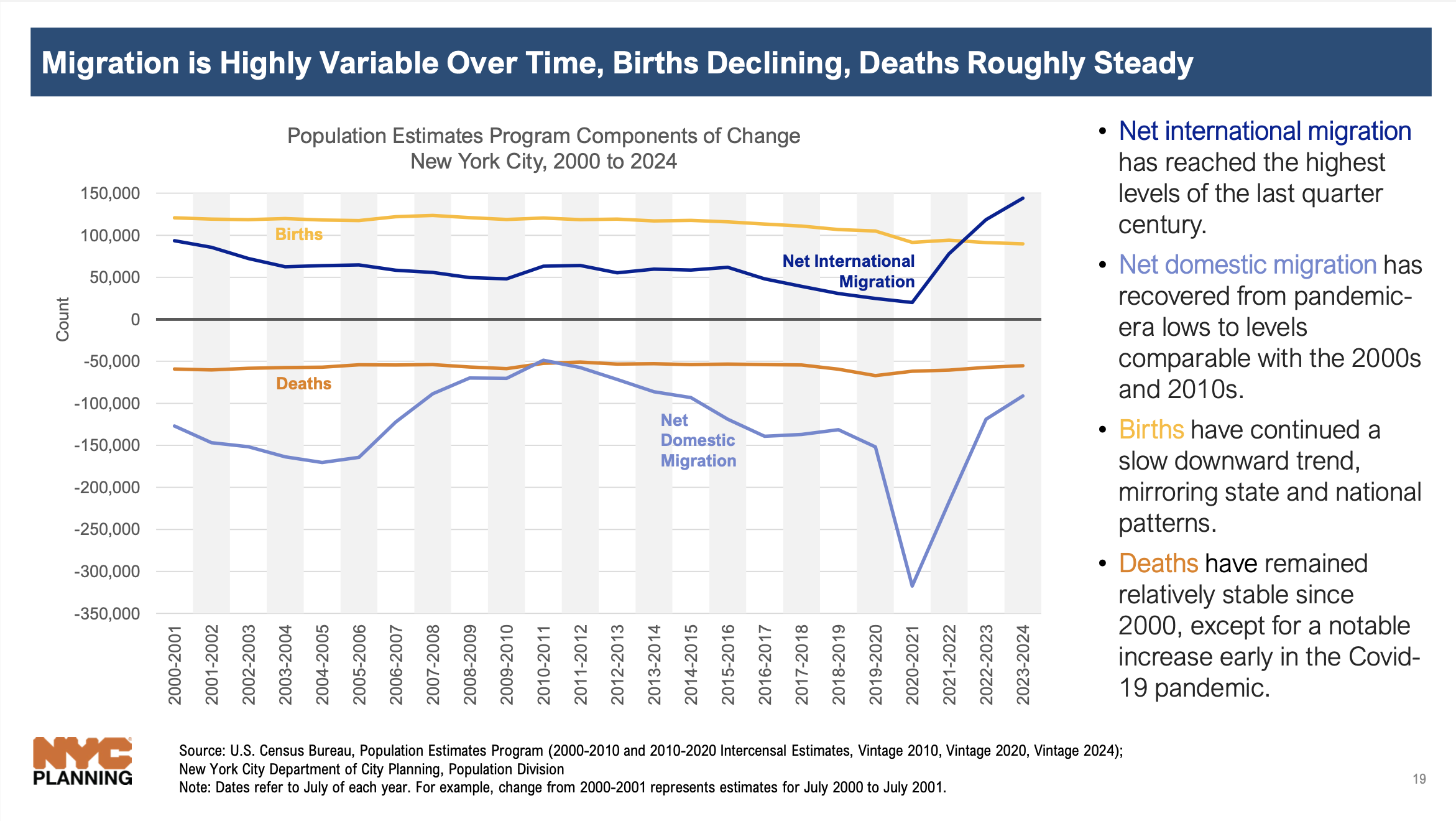
People don’t want to invest in trains because Americans don’t like trains. We have only one real city, and that city’s population consistently has net domestic outmigration. The city’s population is kept stable by a steady supply of international migrants: https://www.cityandstateny.com/media/ckeditor-uploads/2025/0....
Most Americans don’t want to commute sitting next to strangers. It’s not complicated.
They use them heavily when they're available. The NYC subway is very popular and successful, and many see it as a selling point of the city.
> Most Americans don’t want to commute sitting next to strangers.
I never hear city residents talk about 'strangers'. Interacting with others is a pleasure of cities, in fact - it's energizing, it builds social trust. We're social animals. I've never gotten on public transit, or walked down a busy sidewalk, and thought about 'strangers'. Most of those people are pretty sociable.
Some of the people on the subway have eroded social trust by acting antisocially with impunity, a high trust society needs to be beaten into such a diverse and inequal population a la singapore
> They use them heavily when they're available. The NYC subway is very popular and successful, and many see it as a selling point of the city.
NYC has only 2.5% of the U.S. population and even then it has net domestic outmigration (meaning more people move out every year than move in). The city would be shrinking if it wasn’t for international immigrants, who don’t come to the city for the public transit, but rather the welfare system and ethnic social networks.
> The city would be shrinking if it wasn’t for international immigrants, who don’t come to the city for the public transit, but rather the welfare system and ethnic social networks.
I think your numbers are wrong: the city's foreign born population has been stable for at least 15 years[1]. We're not even at historic highs; those were before WWI.
> the city's foreign born population has been stable for at least 15 years
This statement doesn't contradict the one about international immigrants keeping the city from shrinking. It is easy to imagine how immigrants come to NY, give birth to natural born Americans, who then move out of the city. This process can come to some kind of a dynamic equilibrium with a stable population of foreign born people.
Not only that, when an international immigrant to the city later moves out of the city, like my cousin’s family did, that’s also counted as domestic migration.
Did you hear about the woman in Chicago who was set on fire on a train? Not very sociable.
People use the trains in places like Chicago and NYC not simply because they are available but because owning and driving a car in the city center is very expensive and impractical for most people.
Anywhere less dense, people prefer to drive their own cars.
> Did you hear about the woman in Chicago who was set on fire on a train? Not very sociable.
Did you hear about the other other lawsuit about people burning to death in their cybertruck? Should we compare horrific deaths per passenger? Per mile traveled?
once autonomy becomes ubiquitous, it'll change the safety equation significantly and hopefully eradicate the safety advantage of public transit entirely
Law enforcement organizations existed in ancient times, such as prefects in ancient China, paqūdus in Babylonia, curaca in the Inca Empire, vigiles in the Roman Empire, and Medjay in ancient Egypt. Who law enforcers were and reported to depended on the civilization and often changed over time, but they were typically slaves, soldiers, officers of a judge, or hired by settlements and households. Aside from their duties to enforce laws, many ancient law enforcers also served as slave catchers, firefighters, watchmen, city guards, and bodyguards.
By the post-classical period and the Middle Ages, forces such as the Santa Hermandades, the shurta, and the Maréchaussée provided services ranging from law enforcement and personal protection to customs enforcement and waste collection. In England, a complex law enforcement system emerged, where tithings, groups of ten families, were responsible for ensuring good behavior and apprehending criminals; groups of ten tithings ("hundreds") were overseen by a reeve; hundreds were governed by administrative divisions known as shires; and shires were overseen by shire-reeves. In feudal Japan, samurai were responsible for enforcing laws.
The concept of police as the primary law enforcement organization originated in Europe in the early modern period; the first statutory police force was the High Constables of Edinburgh in 1611, while the first organized police force was the Paris lieutenant général de police in 1667. Until the 18th century, law enforcement in England was mostly the responsibility of private citizens and thief-takers, albeit also including constables and watchmen. This system gradually shifted to government control following the 1749 establishment of the London Bow Street Runners, the first formal police force in Britain. In 1800, Napoleon reorganized French law enforcement to form the Paris Police Prefecture; the British government passed the Glasgow Police Act, establishing the City of Glasgow Police; and the Thames River Police was formed in England to combat theft on the River Thames. In September 1829, Robert Peel merged the Bow Street Runners and the Thames River Police to form the Metropolitan Police. The title of the "first modern police force" has still been claimed by the modern successors to these organizations
The Americans do have a history of using Police forces for Slave capture, but Police forces in the USA PRE DATED that
Following European colonization of the Americas, the first law enforcement agencies in the Thirteen Colonies were the New York Sheriff's Office and the edit County Sheriff's Department, both formed in the 1660s in the Province of New York. The Province of Carolina established slave-catcher patrols in the 1700s, and by 1785, the Charleston Guard and Watch was reported to have the duties and organization of a modern police force. The first municipal police department in the United States was the Philadelphia Police Department, while the first American state police, federal law enforcement agency was the United States Marshals Service, both formed in 1789. In the American frontier, law enforcement was the responsibility of county sheriffs, rangers, constables, and marshals. The first law enforcement agency in Canada was the Royal Newfoundland Constabulary, established in 1729, while the first Canadian national law enforcement agency was the Dominion Police, established in 1868.
Yeah I helped out a bit with Freenet before I saw what was being posted. Basically 4chan. Lots of edge lords.
But I helped because a friend dragged me to Amnesty International meetings in college and so I knew there were people who legitimately needed this shit.
Tor is the big example for me, created to allow people to have the ability to speak freely without being tracked, often criticized because it allows those things for our criminals (it has to be kept in mind that the spies and dissidents that are/were using Tor are considered criminals in their country)
When a law is unjust it will be broken by those on the right side of history. Software can’t tell if a law is just or not.
So if you want to support suffragists or underground railroads you’re making software that breaks the law.
Really we are all breaking some law all the time. Which is how oppression works. Selective enforcement. ‘Give me six lines from the most innocent man and I will find in them something to damn his soul.”
There is no such thing as "good" or "bad" - actions are meaningless - it's the context that makes the difference.
Example: Sex
Good when the context is consenting adult (humans)
Bad when the context is not.
Further, "One man's 'freedom fighter' is another man's 'terrorist'" - meaning context is very much in the eye of the beholder.
Couple this with the Taoist? fable "What luck you lost a horse" where the outcome of an event can not really be determined immediately, it may take days, months, years to show.
And you are left with - do we really have any idea on what is right/wrong
So, my philosophical take is - if it leads toward healthy outcomes (ooo dripping with subjective context there...) then it's /likely/ the right thing to do.
When I spoke with an AI on this recently the AI was quick to respond that "Recreational drug use 'feels good' at first, but can lead to a very dark outcome" - which is partly true, but also demonstrates the first point. Recreational drug use is fine (as far as I am concerned, after my 4th cup of tea) as long as the context isn't "masking" or "crutch" (although in some cases, eg. PTSD, drug use to help people forget is a vital tool)
More that they use GPS to synchronize the clocks. Having your own atomic clock doesn’t really improve your accuracy except for within the single data center you have it deployed (although I’m sure there’s techniques for synchronizing with low bounds against nearby atomic clocks + GPS to get really tight bound so they don’t need one in every data center)


I personally prefer a BYD, Musk has damaged his brand by being so political, but the BYD product is (IMO) superior.
Having said that BYD isnt without its issues (eg. over reporting of range)
reply